Governance-focused MCP server that controls AI access to sensitive data
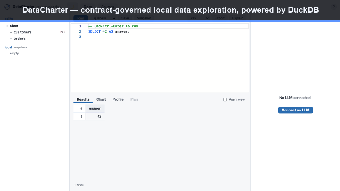
datacharter by Datacharter is a governed Model Context Protocol server that restricts AI agent access to local and remote data. The tool gives agents a SQL-style workspace so they can run queries against federated sources while keeping external exposure limited. It emphasizes privacy safeguards, query auditing, and read-only execution to reduce operational risk. Intended for data engineers, security teams, and developers who need auditable, policy-enforced AI interactions with production and local datasets.
What tasks can you actually use it for?
The server lets language models act as query-capable data assistants inside a controlled environment, enabling analytical queries, basic visualizations, and dataset profiling. Built-in data profiling and chart captioning turn query results into human-readable summaries. Use cases include exploratory analysis of mixed local and enterprise data and generating SQL-backed answers from joined sources, with the tool producing query results rather than unrestricted raw records.
How private and auditable are the tool's outputs?
Privacy controls are applied automatically at query time, with automatic PII masking and k-anonymity suppression stated as part of the design. The system records agent activity using a tamper-evident, hash-chained audit log, producing a verifiable evidence pack for each query. Canary tripwires can be configured to flag accidental data exfiltration attempts, giving security teams traceable alerts tied to specific agent queries.
What inputs and integrations does it accept?
The server federates data through DuckDB and accepts local file formats such as CSV, Parquet, JSON, Excel, and SQLite, plus connections to remote warehouses including Postgres, MySQL, SQL Server, Snowflake, BigQuery, Iceberg, and Delta Lake. Installation paths include Python packages (pip/uvx) and Homebrew, and a standalone desktop build exists in beta. It exposes an MCP server interface for compatible hosts to call.
Is it practical to deploy and fit into existing workflows?
Data handling is local-first by design: the server binds toby default and reports no telemetry, which helps keep queries on-premises. Execution is read-only by construction, preventing accidental writes to data sources. The developer supplies a command workflow (for example, using uvx to initialize a workspace) and integrations with MCP-compatible clients so teams can add the server into agent toolchains without changing production databases.
Best suited for teams that require auditable, policy-driven agent queries
The tool is a practical choice for security-conscious teams that need agent access constrained by enforceable policies; its local-first design and evidence packs help meet compliance goals. Plan for a configuration phase, because meaningful guarantees depend on carefully authored contracts and canary rules in charter.yaml. Expect to keep human review in the loop for high-stakes decisions driven by agent-generated analysis.